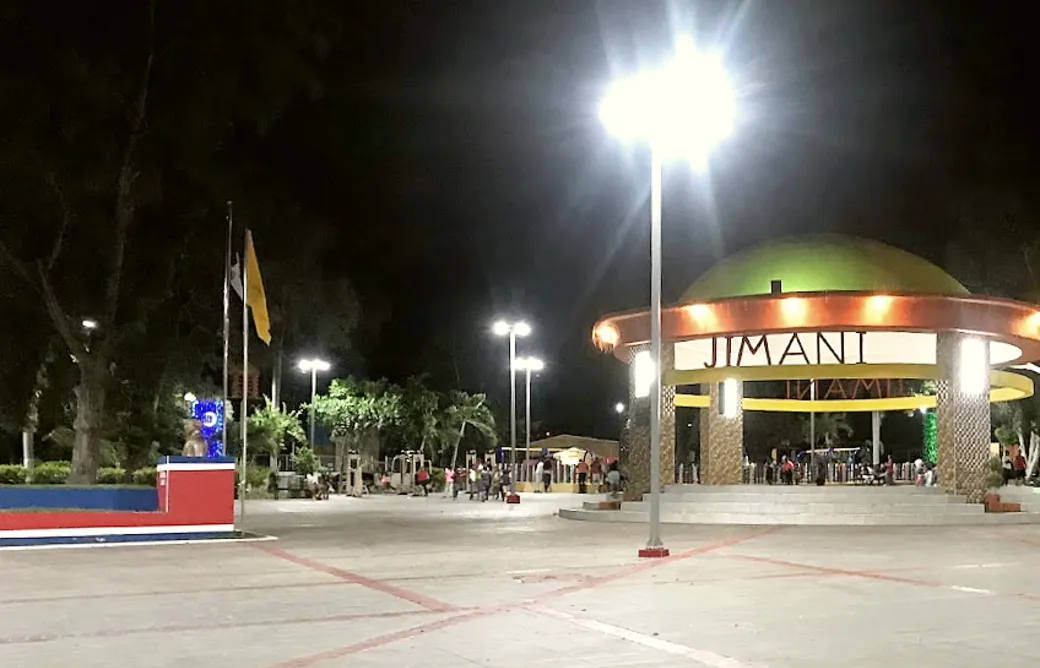
Jimaní
Jimani is the last Dominican town before Haiti, the dusty capital of Independencia Province on the shore of Lago Enriquillo, the largest lake in the Caribbean and one of the lowest points in the Antilles at roughly 46 meters below sea level.
Jimaní
Jimani is the last Dominican town before Haiti, the dusty capital of Independencia Province on the shore of Lago Enriquillo, the largest lake in the Caribbean and one of the lowest points in the Antilles at roughly 46 meters below sea level.
Jimani is the capital of Independencia Province and the last Dominican town before the Haitian border, set in a hot, semi-arid valley near the western edge of Lago Enriquillo. It is not a resort stop. Travelers come for the lake, a hypersaline body of water in a tectonic depression that drops to roughly 46 meters below sea level, one of the lowest points in the Antilles and the largest lake in the Caribbean. Everything else in town, the market stalls, the border traffic, the quiet streets, orbits that geography.
The lake is the reason to detour into this corner of the southwest. Its salt-heavy shallows hold one of the densest concentrations of American crocodiles in the region, plus rhinoceros iguanas, Ricord's iguanas, and flamingos at dawn and dusk. At its center is Isla Cabritos, which gives Lago Enriquillo e Isla Cabritos National Park its name; two smaller islands were submerged as the lake rose in recent decades. Most boat tours launch from La Descubierta on the northern shore rather than from Jimani, so travelers based here drive the shoreline road around to reach them.
Jimani's other identity is as a border town. The Malpasse-Jimani crossing is one of four official gateways between the Dominican Republic and Haiti, long anchored by a binational open-air market. Conditions have been unstable amid Haiti's security crisis, with periods of closure through 2024 to 2026, so the border reads more as a logistics reality than a tourist draw. The town also carries a harder history: on May 24 and 25, 2004, the Solie River overflowed after torrential rain and tore through Jimani, killing several hundred residents in one of the deadliest flash floods in recent Dominican memory.
Getting here means driving, roughly 280 kilometers and about four hours from Santo Domingo on the southern highway through Barahona. There is no commercial airport nearby; most visitors fly into Las Americas in Santo Domingo or La Romana and rent a car or book a guided tour. The dry season, December through April, brings the most reliable roads and clearest lake conditions, though the heat is constant year-round.
Jimani works best as a day trip or overnight add-on to a wider southwest loop, not a standalone base. Pair it with Barahona's coastline, the Bahoruco mountains, or a southwest itinerary linking the lake, the border, and the province's beaches and hot springs. Formal dining is thin, so most travelers eat in Barahona or pack provisions; check restaurant listings for the nearest options. This suits people who want the country's dry, austere southwest over its beaches, and who accept a border town's rougher edges for one of the Caribbean's stranger landscapes.
Jimaní is the gateway to one of the Caribbean's most extraordinary natural wonders — Lago Enriquillo, the largest lake in the entire Caribbean and one of the few places on earth where a saltwater lake sits below sea level. This vast, shimmering expanse of water in the arid Enriquillo Valley feels more like an African rift lake than anything you'd expect to find on a Caribbean island.
The lake is home to a remarkable population of American crocodiles, some reaching over three meters in length, along with rhinoceros iguanas that roam freely on Isla Cabritos — a national park island sitting in the middle of the lake. Flamingos wade through the shallow waters, and the surrounding desert-like terrain creates a landscape unlike anything else in the Dominican Republic.
Jimaní also serves as the main border crossing between the Dominican Republic and Haiti, giving the town a unique cultural energy. The twice-weekly border market draws thousands of traders from both sides, creating one of the most vibrant and chaotic commercial scenes in the entire island of Hispaniola. For travelers seeking the road less traveled, Jimaní offers an experience that no resort or beach town can match.
Weather by month
Warm all year. Each bar's height is that month's average daily high, so the chart rises toward the warm summer; teal marks the drier months with the most reliable beach weather. Temperatures show in °F by default; switch to °C with the toggle.
Best time to visit: Jan, Feb, Mar, Apr, Jul, Nov, Dec. These months bring the most sun and the fewest rainy days; May, Jun, Aug, Sep, Oct are the wettest.
Sample itineraries
Practical information
Photo gallery
Jimaní questions
Can I cross into Haiti from Jimani?
+
Land and sea borders with Haiti are closed to travellers. You will need a valid passport and, depending on your nationality, a Haitian visa. Border crossings can be chaotic and slow. This crossing is used mainly by traders and humanitarian workers. Check current conditions and travel advisories before attempting to cross.
How many days should I spend in the Jimani area?
+
One full day is enough to tour Lago Enriquillo and Isla Cabritos. If you combine it with the Pedernales area (Hoyo de Pelempito viewpoint), plan for two days. Most visitors include Jimani as part of a broader southwest road trip covering Barahona, the Enriquillo Valley, and the Pedernales coast over 3-5 days.
What is Lago Enriquillo and can I see crocodiles there?
+
Lago Enriquillo is the largest lake in the Caribbean and the lowest point in the region at about 40 meters below sea level. It is home to American crocodiles, rhinoceros iguanas, and flamingos. Boat tours from the park ranger station take you to Isla Cabritos in the center of the lake where you can see crocodiles basking on the shore. Check current tour prices before visiting.
Is Jimani safe for tourists?
+
Jimani is generally safe but very much off the tourist trail. The town is small and locals are welcoming. The border area can be hectic during market days. Take extra care on roads close to the border with Haiti, where armed robberies have occurred, including by criminals posing as police officers; avoid travelling after dark. The Lago Enriquillo area itself is managed by park rangers and is safe to visit during the day.
How do I get to Jimani?
+
Jimani is located in the far southwest of the Dominican Republic, about 270 km (4-4.5 hours) from Santo Domingo via Azua and Neyba. A government route survey lists Palejo buses to Jimani from Parada del Sur. A rental car is recommended for flexibility, as the attractions around the lake are spread out.
Keep exploring
Nearby Destinations
Explore more places near Jimaní