María Trinidad Sánchez
A working Atlantic coast province of cliffs, cenotes and coconut farms around Nagua and Rio San Juan, home to Playa Grande's crescent sands and a clifftop Robert Trent Jones golf course, with almost none of the north coast's resort crowds.
María Trinidad Sánchez
A working Atlantic coast province of cliffs, cenotes and coconut farms around Nagua and Rio San Juan, home to Playa Grande's crescent sands and a clifftop Robert Trent Jones golf course, with almost none of the north coast's resort crowds.
Maria Trinidad Sanchez sits on the Dominican Republic's northeastern Atlantic coast, between the Cordillera Septentrional and the open ocean, west of the Samana peninsula. It is not a resort province: the capital, Nagua, is a working town built on rice, coconut and cocoa farming, and the coast runs through fishing settlements rather than all-inclusive strips. It suits travelers who want beach time without the crowds of Punta Cana or Puerto Plata and don't mind more driving between sights. For anyone weighing the north coast against the south or east, it fits into a broader look at the country's destinations.
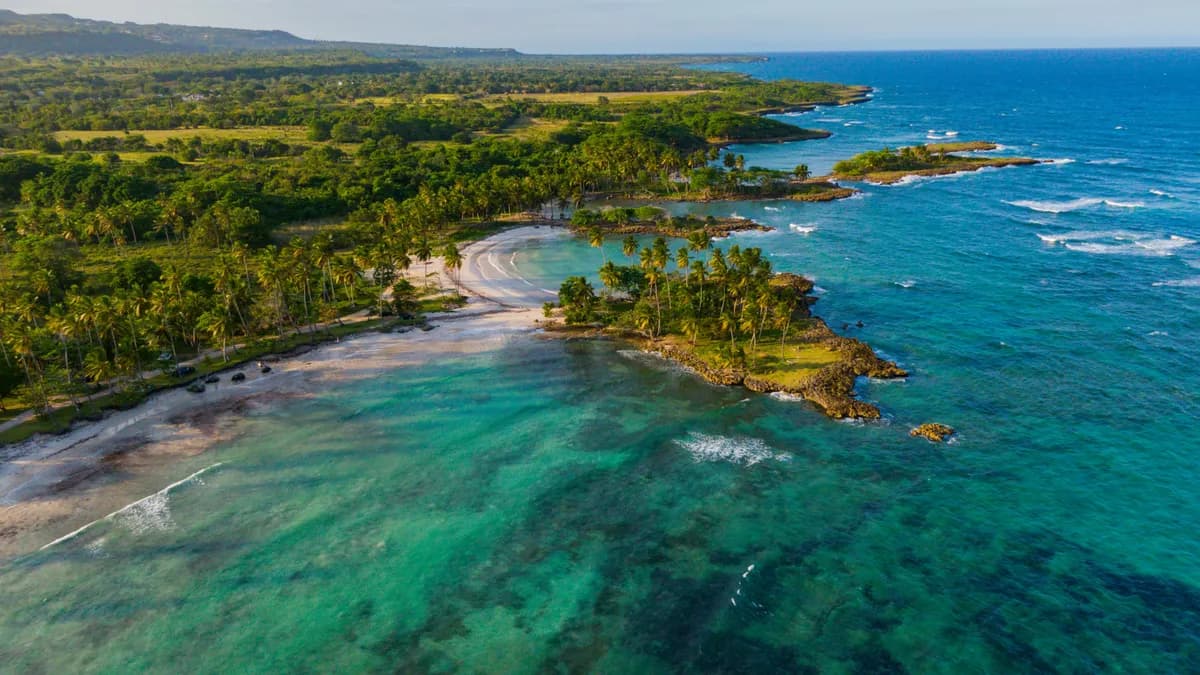
The signature sight is Playa Grande, a crescent of pale sand backed by cliffs and sea grape trees near Rio San Juan, ranked among the country's best beaches. Above it runs Playa Grande Golf and Ocean Club, the last course Robert Trent Jones Sr. designed before his death, opened in 1997 and rebuilt by his son Rees Jones in 2015. Ten of its holes play along ocean cliffs, more than Pebble Beach, which is why golf writers call it the Pebble Beach of the Caribbean. It is now the private course of the Amanera resort, open to guests and members rather than walk-up play. Nearby, Playa Caleton and Playa Diamante are calmer coves for swimming.
Rio San Juan is a low-key fishing town built around the Laguna Gri-Gri, a mangrove-lined lagoon where boatmen run short tours to the Cueva de las Golondrinas sea cave and out to pocket beaches along the shore. Inland toward Cabrera, on the Nagua-Cabrera highway (Route 5), Laguna Dudu is a freshwater cenote open for swimming, cave diving and cliff jumping, one of several karst sinkholes along this coast. On the coast of Cabrera, the Cabo Frances Viejo Natural Monument protects about five square kilometers of coastal cliff, some reaching 30 meters above the Atlantic, with three lighthouses.
Most visitors arrive via the Autopista del Nordeste from Santo Domingo, a drive of roughly two hours to Nagua, or fly into El Catey International Airport near Samana and continue west along the coast road, about an hour to Rio San Juan. Two to three days covers the main beaches, the lagoon tour and Cabo Frances Viejo. Bordering Samana Bay, it also works as a quieter base for the humpback whale season, mid-January through March, paired with time closer to Las Terrenas or Las Galeras. Anyone building a longer trip can check the site's itineraries to sequence it, and local seafood shacks are worth a look on restaurants first.
María Trinidad Sánchez province, with its capital Nagua, occupies a stretch of the northeast coast that tourism largely forgot. That's precisely its appeal. The coastline here is raw and beautiful — long dark-sand beaches backed by coconut groves, river estuaries teeming with birdlife, and a warm, genuine hospitality from people unaccustomed to seeing tourists.
The province is a transition zone between the Samaná Peninsula and the Cibao valley, giving it a unique geography. Mangrove lagoons, mountain foothills, and open ocean coastline create diverse ecosystems within a small area.
Nagua itself is a lively Dominican market town — unpretentious, authentic, and full of local flavor. If you want to experience the Dominican Republic without a tourism filter, this is your place.
Weather by month
Warm all year. Each bar's height is that month's average daily high, so the chart rises toward the warm summer; teal marks the drier months with the most reliable beach weather. Temperatures show in °F by default; switch to °C with the toggle.
Best time to visit: Jan, Feb, Mar, Apr, Jun, Jul, Aug, Sep. These months bring the most sun and the fewest rainy days; May, Oct, Nov, Dec are the wettest.
Sample itineraries
Practical information
Photo gallery
Facts on this page were last compared with their sources on . Details may have changed since. How we check
María Trinidad Sánchez questions
Why should I visit María Trinidad Sánchez?
+
For the authentic, un-touristy Dominican experience. The province offers raw coastline, vibrant local markets, coconut palm forests, and genuine hospitality from people who don't see many foreign visitors. It's the antidote to resort tourism.
Do I need to speak Spanish?
+
Almost essential. Very few people in Nagua and surrounding areas speak English. Basic Spanish phrases or a translation app will make your experience much richer and smoother.
What's the best beach in the area?
+
The coastline has several beautiful dark-sand beaches, often completely deserted. The area near El Factor has particularly scenic stretches. Explore the coast road and discover your own spot.
Is it safe to travel here?
+
Yes — the province is generally safe and low-crime. The main concern is swimming safety — the Atlantic surf can be powerful with rip currents. Swim with caution and pay attention to local advice about conditions.
How do I combine it with other destinations?
+
Best combined with a Samaná Peninsula trip — Las Terrenas is about 1 hour east. The contrast between touristy Las Terrenas and authentic Nagua is fascinating. Also reachable from Cabarete (2 hours west).
Keep exploring
Nearby Destinations
Explore more places near María Trinidad Sánchez