La Romana & Bayahíbe Travel Guide
La Romana and Bayahibe travel guide to Casa de Campo, Altos de Chavon, Isla Saona boat trips, and scuba diving off Catalina island.
The southeast coast of the Dominican Republic is a study in contrasts. On one side: La Romana, a working sugar-mill city with a legendary resort so exclusive that it has its own airport, three Pete Dye golf courses, an Italian hilltop village replica, and a celebrity guest list that reads like a Forbes 500 roster. On the other: Bayahíbe, a former fishing village turned scuba diving hub where weather-beaten captains run boats to uninhabited islands and the beer is cheaper than the bottled water.
Together they form a destination that spans the entire Dominican travel spectrum, from US$1,000-a-night villas with private butlers to US$30 guesthouses where the owner's grandmother cooks your breakfast. This guide covers both worlds and everything between them, including the national park, the island day trips, the diving, and the practical details that help you decide how to split your time.
Overview: Luxury Meets Local
La Romana is the Dominican Republic's fourth-largest city (population ~190,000), built around the Central Romana sugar corporation, one of the largest sugar producers in the Caribbean. The city itself is not a tourist destination; it is a working Dominican city with little to detain visitors beyond a stop for gas or groceries. The tourism is concentrated in two satellites: Casa de Campo, the 7,000-acre luxury resort 5 km east of the city, and Bayahíbe, the beach-and-diving village 25 km further east.
The distance between these two worlds is more than geographical. Casa de Campo guests arrive by private jet, play golf on courses ranked among the world's best, dine at restaurants where entrées cost more than a week's meals in Bayahíbe, and never need to leave the compound. Bayahíbe visitors eat grilled fish at beachfront shacks, negotiate boat prices in broken Spanish, and share the dive boat with French retirees and Dominican newlyweds on budget honeymoons. Both experiences are valid, both are excellent, and the savvy traveler will sample both.
The region also serves as the gateway to Parque Nacional Cotubanamá (formerly Parque Nacional del Este), which protects Isla Saona and some of the best coral reefs in the Caribbean. Whether you come for luxury golf, barefoot diving, or a catamaran day trip with unlimited rum, the La Romana-Bayahíbe corridor delivers.
Casa de Campo
Casa de Campo is not just a resort, it is a self-contained world. Established in 1974 by Gulf+Western Industries (then owners of the Central Romana sugar corporation), the property spans 7,000 acres (28 km²) and includes three golf courses, a 370-slip marina, a polo field, an equestrian center, a shooting range, 13 restaurants, a private airport, and Altos de Chavón, a full-scale replica of a 16th-century Mediterranean village.
Golf
The undeniable centerpiece. Casa de Campo has three Pete Dye-designed courses, and one of them, Teeth of the Dog: is consistently ranked the #1 golf course in the Caribbean and among the top 50 in the world. Seven of its holes play directly along the ocean, with tees perched on coral cliffs above crashing waves. It is visually spectacular and technically demanding. Green fees for Teeth of the Dog: US$400 per round for hotel guests and US$550 for non-hotel registered guests, plus 18% tax. The other two courses, Dye Fore (27 holes with cliff-top views over the Chavón River) and The Links (an inland course), are also excellent, with hotel-guest rates of US$325 for Dye Fore and US$250 for The Links per round, plus 18% tax.
Marina
The Casa de Campo Marina is a Caribbean marina, with 370 slips accommodating yachts up to 250 feet. Even if you are not a yacht owner, the marina village is worth a visit for its restaurants, shops, and waterfront promenade. The architecture is Mediterranean-inspired, and the vibe is affluent-casual, linen shirts and boat shoes. Deep-sea fishing charters depart from the marina (half-day from US$500-800 for a shared boat, US$1,200-2,000 private) targeting marlin, dorado, and wahoo.
Staying at Casa de Campo
Accommodation ranges from hotel rooms (from US$250/night) to multi-bedroom villas (US$500-5,000+/night). The villas are the signature experience, sprawling properties with private pools, staff, and golf cart transportation around the resort. Many are privately owned and rented through the resort's management program. For families and groups, villas offer better value per person than hotel rooms. Book directly through Casa de Campo for access to golf and activity packages.
Altos de Chavón
Perched on a cliff 90 meters above the Río Chavón, Altos de Chavón is a replica of a 16th-century Mediterranean village built in the 1970s-1980s by Italian filmmaker Roberto Coppa and Dominican architect José Antonio Caro. The village was constructed entirely from local stone using traditional techniques, and the result is strikingly authentic, cobblestone streets, wrought-iron balconies, stone archways, and a 5,000-seat Greek-style amphitheater that has hosted Frank Sinatra, Julio Iglesias, Sting, and Andrea Bocelli.
Beyond the architecture, Altos de Chavón houses the Altos de Chavón School of Design (affiliated with Parsons in New York), an archaeological museum with the best collection of Taíno artifacts in the region, several art galleries, and a handful of restaurants and shops. Ordinary village access is limited to hotel guests, residents, and their guests and is a standard stop for tour groups from Punta Cana. Visit early morning or late afternoon to avoid the crowds and catch the best light on the stone buildings.
The view of the Río Chavón from the amphitheater terrace, a deep, jungle-lined gorge opening to the Caribbean, is one of the most dramatic vistas in the Dominican Republic. The same river served as the filming location for scenes in Apocalypse Now and Jurassic Park, standing in for Vietnam and Costa Rica respectively.
Bayahíbe: The Diving Capital
Bayahíbe is a small village (population ~3,000) that has grown from a fishing community into the diving and excursion capital of the Dominican Republic's southeast coast. The village sits at the edge of Parque Nacional Cotubanamá, giving it immediate access to some of the best reefs, wrecks, and island beaches in the Caribbean.
The village itself is pleasant and walkable, a handful of streets with guesthouses, dive shops, restaurants, and a small public beach (Playa Bayahíbe) where fishing boats and dive boats bob at anchor. The pace is slow, the vibe is laid-back, and the community is a mix of Dominican locals, European expats (heavily Italian and French), and traveling divers.
West of the village, Playa Dominicus is a wider, whiter beach lined with all-inclusive resorts (Iberostar, Dreams, Viva Wyndham). Dominicus is the place for resort-style vacations with organized entertainment, buffets, and beach chairs. Bayahíbe village is for independent travelers who want more autonomy and lower prices.
Isla Saona Day Trip
Let's be honest about what an Isla Saona day trip actually is. It is the most popular excursion in the Dominican Republic, roughly 500,000 people per year make the trip, and it is simultaneously beautiful and chaotic.
The standard package works like this: a bus picks you up at your hotel (5:30-7:00 AM), drives to Bayahíbe, loads you onto a catamaran or speedboat, and crosses to Isla Saona (45-90 minutes depending on boat type). You spend 3-4 hours on a beautiful white-sand beach with palm trees, a BBQ lunch on the sand, unlimited rum punch and Presidente beer, and a stop at the natural pool (a shallow sandbar where you wade in waist-deep water). Then the catamaran back, a bus ride, and you are at your hotel by 5-6 PM. Cost: RD$3,500-6,000 (US$59-100) per person from Bayahíbe; RD$5,000-8,000 (US$85-135) with hotel pickup from Punta Cana.
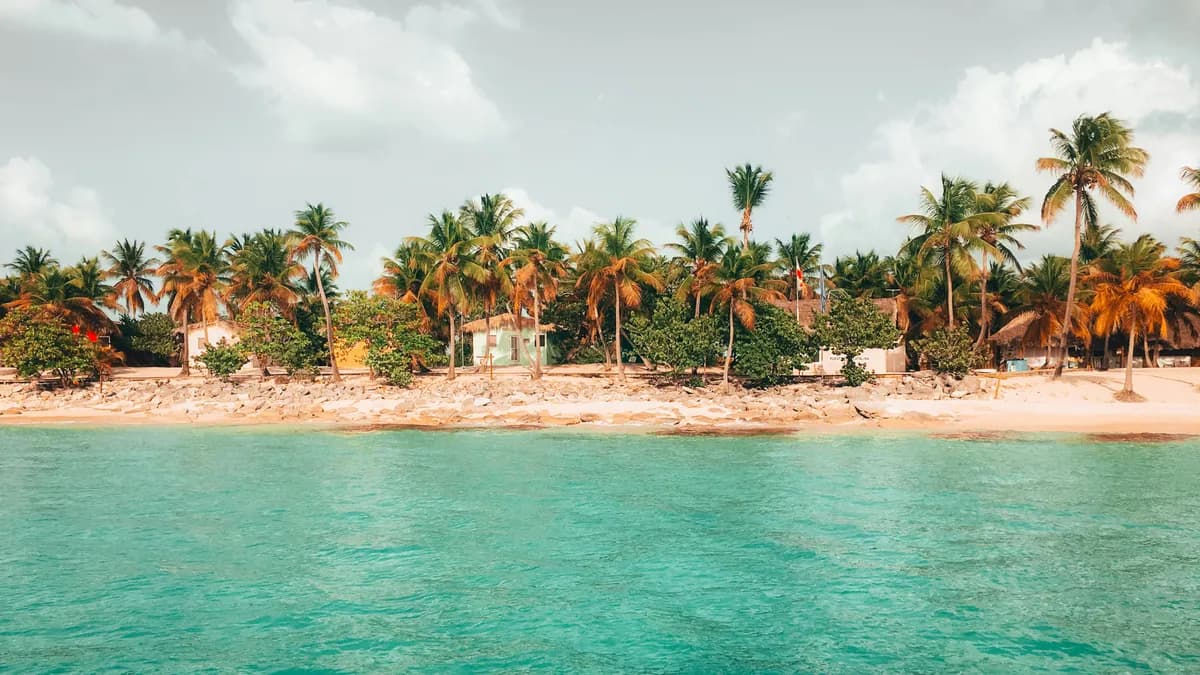
The beach is genuinely gorgeous, wide, palm-lined, and backed by jungle. The water is warm and calm. The food is decent. The rum is free-flowing. The catch: you will share the beach with hundreds of other tourists from dozens of boats. The music is loud. The vendors are persistent. It feels more like a beach party than a deserted island.
The alternative: Book a private speedboat from Bayahíbe (RD$8,000-15,000 / US$135-250 for up to 6 passengers) and visit the more remote beaches of Saona, which some small-group tours also reach. Small-group tours also visit these beaches. Bring your own food and drinks. This is a dramatically different experience, same island, different planet.
Isla Catalina
A smaller, less-visited island than Saona, Isla Catalina lies 2 km off the La Romana coast and is the better choice for snorkeling and diving. The coral reef on the island's east side, known as "The Wall": drops from 5 meters to 30+ meters in a dramatic underwater cliff face covered in sponges, sea fans, and coral. The snorkeling alone is world-class: swim from the beach and within 50 meters you are floating over a reef teeming with tropical fish.
Day trips to Isla Catalina depart from the Casa de Campo Marina or from La Romana's port. Tour packages cost RD$3,500-5,000 (US$59-85) per person including transport, snorkel gear, lunch, and drinks. Private boat charters (for divers or small groups) cost RD$12,000-18,000 (US$200-300) for a full day. The island has basic facilities (restrooms, beach chairs) set up by the tour operators but is otherwise undeveloped.
Isla Catalina is also where the 1699 shipwreck of Captain Kidd's vessel the Quedagh Merchant was discovered in 2007, making the surrounding waters historically significant as well as biologically rich.
Parque Nacional Cotubanamá
Parque Nacional Cotubanamá (renamed from Parque Nacional del Este in 2014, honoring the Taíno chief who resisted Spanish colonization) protects 791.9 km² of marine and terrestrial habitat along the southeast coast, according to the country's UNESCO submission. The park includes Isla Saona, mangrove coastline, dry subtropical forest, and extensive coral reef systems.
Beyond the island day trips, the park offers several less-visited experiences:
- Padre Nuestro Trail: A 2-km walking trail through subtropical forest starting from the park entrance near Bayahíbe. The trail leads to a freshwater cenote (a natural sinkhole pool) and Taíno cave paintings. Confirm the current entrance fee before visiting. Allow 2 hours for the round trip.
- Catuano Beach: An isolated beach within the park accessible only by boat from Bayahíbe. Located on Saona Island, with excellent snorkeling directly off the sand.
- Mangrove Kayaking: Some dive operators in Bayahíbe offer guided kayak tours through the park's mangrove channels (RD$1,500-2,500 / US$25-42 per person, 2-3 hours). The mangroves are nurseries for juvenile fish, and the birdwatching is excellent, watch for frigatebirds, brown pelicans, and the roseate spoonbill.
Scuba Diving Spots
Bayahíbe is the best base for scuba diving on the southeast coast, with easy access to over 20 dive sites ranging from shallow coral gardens to deep walls and shipwrecks.
Top Dive Sites
- St. George Wreck: A 73-meter Scottish freighter intentionally sunk in 1999 at 40 meters depth. The wreck is intact and encrusted with coral, with large schools of horse-eye jacks swirling around the superstructure. For advanced divers (minimum 30 dives).
- Catalina Wall: The dramatic underwater cliff face off Isla Catalina's east coast. The wall drops from 5 to 30+ meters and is covered in sponges, soft corals, and sea fans. Nurse sharks, eagle rays, and sea turtles are regular visitors. Suitable for intermediate and advanced divers.
- Guaraguao Reef: A shallow reef (8-15 meters) perfect for beginners and snorkelers. Colorful coral formations with parrotfish, angelfish, and schools of blue tangs. Located 10 minutes by boat from Bayahíbe.
- The Aquarium: A sheltered site off Catalina with calm water and abundant marine life. Maximum depth 12 meters. The go-to spot for Discover Scuba dives and beginner certification.
Dive Operators
- Scuba Fun Bayahíbe: The largest and most established dive operation, with a full fleet of boats and PADI-certified instructors in English, Spanish, French, and Italian. 2-tank boat dive: RD$4,500-6,000 (US$75-100). PADI Open Water certification: RD$18,000-24,000 (US$300-400). Equipment is included in the certification course; dive-package equipment rental costs US$10 per day.
- Dressel Divers (Playa Dominicus): A Spanish-owned chain with a base at the Iberostar resort. Professional operation with good equipment and multilingual staff. Prices are similar to Scuba Fun.
Diving tips: Visibility averages 20-30 meters and water temperatures stay at 26-29°C year-round, you can dive comfortably in a 3mm wetsuit or even a rashguard. The best visibility is May through September. Night dives at Guaraguao Reef reveal a completely different ecosystem, octopus, lobster, and nurse sharks that hide during the day. If you are not certified, the Discover Scuba program lets you do a single guided dive (maximum 12 meters) after a 2-hour pool session for RD$3,500-4,500 (US$59-75). Many visitors arrive as non-divers and leave with a PADI certification and a new obsession.
The reefs in Parque Nacional Cotubanamá are among the healthiest in the Caribbean, partly because the park's protected status limits fishing and anchoring. If you care about marine conservation, choose an operator that uses mooring buoys instead of anchors and follows responsible diving practices.
Where to Eat
Bayahíbe Village
- Saona Café: The social hub of Bayahíbe, facing the beach. Italian-Dominican menu with fresh seafood, wood-fired pizza, and cold beer. Grilled lobster RD$900-1,400 (US$15-24), pizza RD$400-600 (US$7-10). The sunset view from the terrace is the best in the village.
- Mare Nostrum: Italian restaurant run by a couple from Naples. The pasta is handmade daily, and the seafood risotto is exceptional. Mains RD$600-1,200 (US$10-20). Small and popular, reserve for dinner in high season.
- Comedor La Bahía: Dominican home cooking on a side street behind the beach. La bandera with fried fish for RD$250-350 (US$4-6). The whole fried fish with coconut rice is the standout.
La Romana
- Pizzeria Di Roma (downtown La Romana): A local favorite for thin-crust pizza at reasonable prices. Pizzas RD$350-600 (US$6-10). Not a tourist spot, you will eat alongside Dominican families.
- Onno's Bar (Altos de Chavón): Dining with views over the Chavón River. The menu runs from sushi to Dominican classics. Mains RD$800-2,000 (US$13.50-34). The views over the Chavón River are the appeal.
Where to Stay
Luxury (US$200-1,000+/night)
- Casa de Campo Resort & Villas: The flagship property. Hotel rooms from US$250/night, villas from US$500/night (up to US$5,000+ for beachfront estates). Golf, marina, Altos de Chavón, multiple pools, and full-service spa. The quintessential Dominican luxury experience.
Mid-Range (US$70-180/night)
- Iberostar Hacienda Dominicus (Playa Dominicus): A solid all-inclusive with a beautiful beach, multiple pools, and organized activities. Doubles from US$120/night all-inclusive. Good for families who want resort comfort near Bayahíbe's dive sites.
- Dreams Dominicus La Romana: Another strong all-inclusive option on Playa Dominicus. Modern rooms, spa, and excellent kids' club. Doubles from US$150/night all-inclusive.
Budget (US$25-70/night)
- Hotel Bayahíbe: Simple but clean hotel in the village center, steps from the beach and dive shops. Doubles from US$40-60/night with AC and breakfast. The owner helps arrange dive trips and island excursions.
- Cabañas Tito: Budget guesthouse near the Bayahíbe beach. Basic rooms with fan or AC, shared kitchen. Confirm room rates directly before booking. Not fancy but perfectly functional for divers who spend most of their time underwater.
- Airbnb (Bayahíbe area): Apartments and studios from US$30-60/night. Look for places with kitchen access to save on meals.
Getting There
The closest airport is La Romana International Airport (LRM), approximately 20 minutes from Bayahíbe. Private transfers from PUJ cost US$60-90 to Bayahíbe, US$50-80 to La Romana. Shared shuttles are available for US$25-35 per person through most tour operators.
La Romana International Airport (LRM): also known as Casa de Campo International, receives flights from Miami, New York, and select Caribbean destinations. It is primarily used by Casa de Campo guests and is only 10 minutes from the resort.
From Santo Domingo, La Romana is approximately 1.5 hours east via the Autopista del Este (Highway 4). Comfortable express buses (Autobuses Espreso Bávaro) depart from Santo Domingo's terminal at Parque Enriquillo every 30-60 minutes (RD$350 / US$6). From La Romana, guaguas run to Bayahíbe (RD$100-150 / US$1.70-2.50, 30 minutes).
From Punta Cana resorts, most tour operators offer day trips to Altos de Chavón, Isla Saona, and Isla Catalina with hotel pickup included. Self-drivers: the road from Punta Cana to La Romana is well-paved and takes about 1 hour.
Frequently Asked Questions
Is La Romana worth visiting if I am not staying at Casa de Campo?
Yes, but with a different focus. Skip La Romana city itself (it is not a tourist destination) and base yourself in Bayahíbe for diving, island trips, and the national park. Ordinary village access is limited to hotel guests, residents, and their guests. The marina village is also accessible and worth a lunch stop. You do not need to be a Casa de Campo guest to enjoy the region's highlights.
Is Isla Saona worth the hype?
It depends on your expectations. If you want a deserted island experience, no, the standard day trip is crowded and party-oriented. If you want a fun, social day with a beautiful beach, unlimited drinks, and zero responsibility, yes, it delivers exactly that. For a quieter experience, book a private speedboat to the eastern end of Saona or visit Isla Catalina instead, which has better snorkeling and fewer people.
La Romana vs Punta Cana, which is better?
They serve different travelers. Punta Cana has more resorts, more nightlife, more shopping, and a bigger international airport. La Romana-Bayahíbe has better diving, better golf (Casa de Campo vs Punta Cana courses is no contest), Altos de Chavón, a more authentic village atmosphere in Bayahíbe, and direct access to Parque Nacional Cotubanamá. Choose Punta Cana for a classic resort vacation. Choose La Romana-Bayahíbe for diving, golf, culture, or a more low-key experience.
How many days do I need?
Three days covers the highlights: Day 1 for Altos de Chavón and the marina, Day 2 for Isla Saona or Isla Catalina, Day 3 for diving or the national park's Padre Nuestro trail. Five to seven days allows for multiple dive days, golf at Casa de Campo, and a trip to both islands. Divers should plan for at least 4 days to access the best sites with sufficient surface intervals.
Facts on this page were last compared with their sources on . Details may have changed since. How we check
Table of Contents
La Romana
This guide covers La Romana. Explore more about this destination.
View DestinationAbout the Author
Alex Borshch
Founder and editor of the Isla365 network. Spent six months living in the Dominican Republic over the 2013-14 winter, and has since wintered in Thailand, Vietnam and Turkey. Writes and edits the guides across the network.