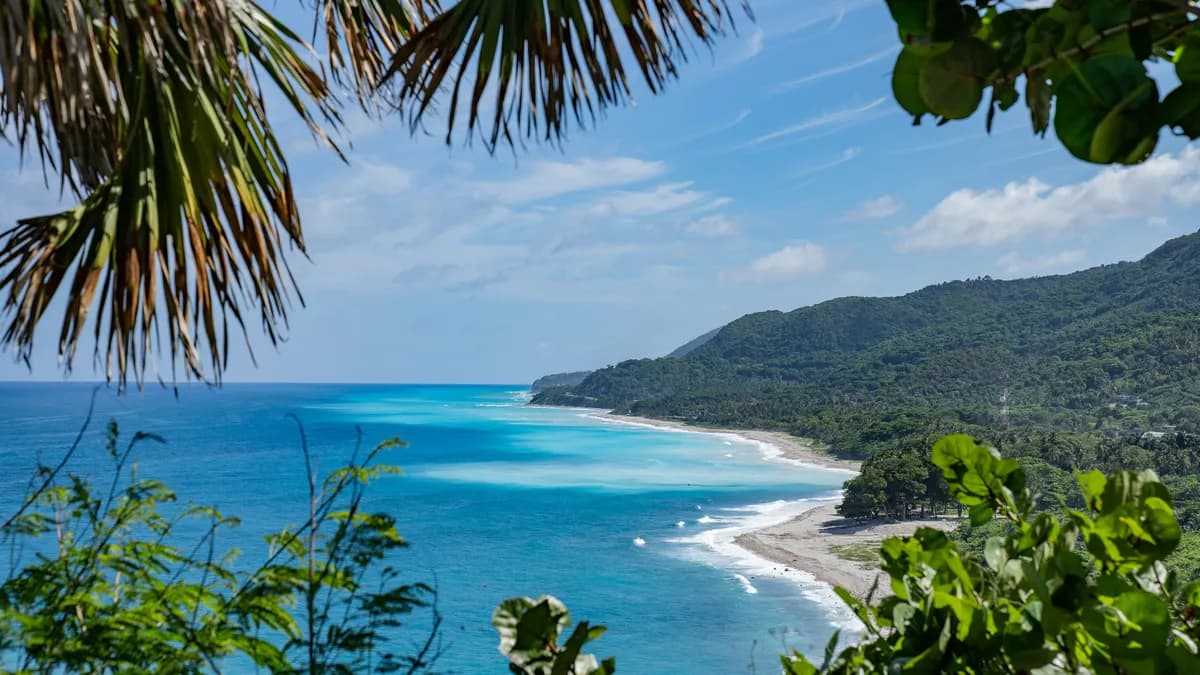
Barahona & the Southwest: DR Off the Beaten Path
Barahona travel guide to the southwest Dominican Republic: Bahia de las Aguilas beach, Larimar mines, Lago Enriquillo, and coffee country road trips.
Most visitors to the Dominican Republic never make it past the eastern resort corridors. They fly into Punta Cana, bus to Santo Domingo, maybe venture to Samaná, and leave thinking they have seen the country. They have not. The southwest is another Dominican Republic entirely: wilder, emptier, more geologically dramatic, and almost completely free of the tourist infrastructure that defines the rest of the island.
This is where you will find Barahona, a crumbling coastal city surrounded by some of the most extraordinary landscapes in the Caribbean, a beach so pristine that National Geographic called it the best in the region, a saltwater lake with American crocodiles and rhinoceros iguanas, mines that produce a semi-precious gemstone found nowhere else on Earth, and mountain villages where coffee grows at altitudes that rival Guatemala. If you have already done Punta Cana and want something radically different, the southwest is the trip.
Why Go Southwest
The southwest is for travelers, not tourists. This is an important distinction. There are no all-inclusive resorts, no airport shuttles, no English menus (with rare exceptions). Locally operated excursion packages are available. What there is: raw, unpackaged Dominican life set against landscapes that shift from arid desert to tropical rainforest within a 30-minute drive.
The region combines three distinct ecosystems in a remarkably small area. The coastal road south of Barahona hugs cliffs above a turquoise sea, passing through fishing villages where the day's catch is grilled on the roadside. Inland, the Hoya de Enriquillo, a geological depression 40 meters below sea level, holds the Caribbean's largest lake, surrounded by cactus-studded terrain that looks more like Arizona than the tropics. And above it all, the Sierra de Bahoruco mountains rise to over 2,000 meters, draped in cloud forest and coffee plantations where temperatures drop to 10°C at night.
The southwest also has the lowest tourist density in the Dominican Republic. On a given day at Bahía de las Águilas, an 8-km beach regularly ranked among the world's most beautiful, you might share the sand with fewer than 20 people. Compare that to Bávaro Beach, where thousands jostle for space daily. If solitude and authenticity matter to you more than convenience, the southwest delivers like nowhere else in the Caribbean.
Road Trip from Santo Domingo
The drive from Santo Domingo to Barahona is approximately 3.5-4 hours (200 km) via the Carretera Sánchez (Highway 44), passing through Azua and Baní. The road is paved and generally in decent condition, though the stretch between Azua and Barahona has sections with potholes that require attention. A 4x4 is not necessary for the highway itself but becomes very useful for the coastal road south of Barahona and essential for Bahía de las Águilas.
Suggested Itinerary
- Day 1: Drive Santo Domingo to Barahona (3.5 hours). Stop in Azua for lunch at a roadside comedor, the chivo guisado (stewed goat) in this region is the best in the country. Settle into your hotel in Barahona and explore the Malecón at sunset.
- Day 2: Drive the coastal road south, San Rafael waterfall, Paraíso, Los Patos. Swim in the river pools at San Rafael, subject to local conditions and eat fresh fish at a beachside parada.
- Day 3: Bahía de las Águilas day trip from Pedernales or La Cueva (boat ride to the beach, full day). This is the highlight of the entire trip.
- Day 4: Lago Enriquillo and Isla Cabritos. See crocodiles and iguanas in a landscape that defies Caribbean expectations.
- Day 5: Larimar mines in the morning, then mountain drive to Polo or Cachote for coffee and cloud forest. Return to Barahona or continue to Constanza for a mountain extension.
- Day 6: Drive back to Santo Domingo or continue southwest to Pedernales and Jaragua National Park.
Fuel note: Fill up in Barahona. Gas stations become scarce south of the city, and the road to Pedernales has long stretches without services. Carry extra water, snacks, and cash, card machines are unreliable outside Barahona.
Barahona City
Barahona (population ~85,000) is not a tourist destination in itself. It is a working Dominican city built around an operating sugar mill, a busy port, and a surprisingly lively central market. The Malecón (waterfront promenade) is pleasant at sunset, with families eating frituras and kids playing on the seawall. The Parque Central has a small cathedral and the usual collection of colmados blasting bachata.
What Barahona does well is serve as a base. It has ATMs (Banco Popular and BanReservas on Calle Jaime Mota), the best selection of hotels, and supermarkets for stocking up before heading south. The city also has a few genuinely good restaurants, a lively baseball culture (Barahona's amateur leagues are fiercely competitive), and a warmth to its residents that comes from seeing very few foreign faces, when you walk down the street, people stare not out of hostility but genuine curiosity. You are a novelty here, and that novelty earns you generous hospitality.
The Coastal Road Highlights
The road south from Barahona to Enriquillo is one of the most scenic drives in the Caribbean, a winding two-lane road carved into cliffs above the sea, passing through small fishing villages and past beaches that appear around every bend. This is the heart of the southwest experience.
Playa San Rafael
Arguably the most famous stop on the coastal road, San Rafael is where a freshwater river cascades down from the mountains and meets the sea, creating natural pools of cold, crystal-clear water surrounded by smooth boulders. Dominicans from across the region come here on weekends to swim in the pools, eat fried fish at the paradas (small restaurants), and blast music from car speakers. On weekdays, you might have the pools to yourself. The water temperature is shockingly cold compared to the sea, 18-20°C versus 28°C, and the contrast is exhilarating. Entrance is free. Parking costs RD$100 (US$1.70). The fried fish at any of the paradas runs RD$350-500 (US$6-8.50) for a whole red snapper with tostones and salad.
Paraíso
The village of Paraíso ("Paradise") lives up to its name, barely. It is a sleepy fishing community with a rocky beach, colorful wooden houses, and absolutely nothing to do, which is the entire point. The beach is not postcard-perfect (it is pebbly and the water can be rough), but the village has a couple of decent small hotels and the freshest seafood on the coast. Paraíso is also the closest base to Bahía de las Águilas if you do not want to drive all the way to Pedernales.
Los Patos
Named after the river that runs through it, Los Patos is a tiny village where the Río Los Patos, claimed to be the shortest river in the world at just 500 meters, rushes down from the mountains into the sea. The river is icy cold and forms a natural swimming pool where locals and visitors cool off. A cluster of paradas serves fried fish, mangú, and cold Presidente. Los Patos is a perfect 30-minute stop on the coastal drive.
Bahía de las Águilas
This is it. The reason to come to the southwest. Bahía de las Águilas is an 8-km crescent of white sand within Jaragua National Park, consistently ranked among the most beautiful beaches in the world. The sand is fine and white, the water is impossibly clear and turquoise, and there is nothing, no buildings, no vendors, no beach chairs, no music, except the beach, the sea, and the dry desert cliffs rising behind you.
Getting there requires effort, which is exactly why the beach stays pristine. From the fishing village of La Cueva (about 30 minutes south of Pedernales), small boats make the 15-minute crossing to the beach. Boat fares may be advertised per person or per group; confirm the total for your group before booking. The boatman will agree on a pickup time, usually 4-5 hours later. Bring everything you need: water, food, sunscreen, shade (there is none naturally, some visitors bring a small tent or umbrella). There are no facilities whatsoever.
Alternatively, you can drive to the beach overland from Pedernales via a rough dirt road (4x4 essential, 45 minutes). This approach is cheaper but less scenic and brutally bumpy.
Pro tip: Go on a weekday. On weekends, especially Dominican holiday weekends, local groups arrive with generators, speakers, and coolers of Presidente, and the solitude disappears. On a Tuesday in March, you will have a kilometer of beach to yourself. Bring reef-safe sunscreen, this is a national park, and the reef offshore is pristine.
Larimar Mines & Museum
Larimar is a variety of blue pectolite found only in the Dominican Republic, specifically in the mountains above Barahona near the village of Los Chupaderos. The stone ranges from white to deep volcanic blue, and the finest specimens rival turquoise in beauty. Dominican artisans have been crafting larimar jewelry since the 1970s, and it has become the country's officially designated national stone.
You can visit the Larimar mines near Los Chupaderos, about 10 km southwest of Barahona in the foothills of the Sierra de Bahoruco. The mines are artisanal, narrow shafts dug by hand into the mountainside by independent miners. It is not a polished tourist experience: you walk on muddy trails, peer into dimly lit tunnels, and watch miners extract rough larimar by hand. A local guide is necessary and costs RD$500-1,000 (US$8.50-17). The miners will sell you rough stones for RD$200-1,000 (US$3.50-17) depending on size and color quality. You can also buy finished jewelry at significantly lower prices than in Santo Domingo or Punta Cana.
The Larimar Museum in Barahona province, the Escuela Taller y Museo Larimar on the Barahona to Paraíso road, has a small but informative exhibition on the geology, mining history, and cultural significance of the stone. Admission is a nominal fee; check current hours and price locally before making the trip. The attached shop sells high-quality pieces at fair prices.
Buying tip: The deeper and more vivid the blue, the more valuable the stone. Pale or heavily veined pieces are common and inexpensive. Deep "volcanic blue" specimens are rare and can fetch hundreds of dollars even uncut. If a vendor in Punta Cana is selling "larimar" for RD$50, it is almost certainly fake.
Lago Enriquillo & the Dry Valley
Lago Enriquillo is the largest lake in the Caribbean (265 km²) and one of the most surreal landscapes you will encounter anywhere. Located in the Hoya de Enriquillo, a tectonic depression 40 meters below sea level, the lake is hypersaline (saltier than the ocean) and sits in an arid, cactus-studded valley that looks nothing like any Caribbean postcard you have ever seen.
The lake is home to a wild population of American crocodiles, rhinoceros iguanas (the prehistoric-looking endemic reptile of Hispaniola), and flocks of flamingos that feed in the shallow salt flats. Isla Cabritos, an island in the center of the lake, is a national park and the primary destination for visitors.
Boat tours to Isla Cabritos depart from the town of La Descubierta on the lake's north shore. The crossing takes about 30 minutes and costs RD$2,500-4,000 (US$42-67) per boat (up to 6 passengers). On the island, a park ranger guides you along trails where iguanas bask in the sun within arm's reach and crocodiles lounge on the muddy shoreline. The experience is otherworldly, you are in the Caribbean, 40 meters below sea level, surrounded by cactus and crocodiles.
Timing: Go early morning (before 9 AM). The valley heats up ferociously, temperatures routinely exceed 40°C by midday. Bring at least 2 liters of water per person, a hat, and strong sunscreen. The park entrance fee is RD$100 (US$1.70).
Sierra de Bahoruco & Coffee Country
Above the coastal heat and the desert valley, the Sierra de Bahoruco rises to 2,367 meters at Loma del Toro. The mountain range is a UNESCO Biosphere Reserve, home to 166 species of orchids, many bird species endemic to Hispaniola, and some of the last remaining cloud forest in the Caribbean.
Polo & Polo Magnético
The mountain village of Polo (elevation 800m) is the center of the southwest's coffee-growing region. Dominican coffee from this area, shade-grown at altitude in volcanic soil, is excellent, and several small farms offer informal tours. Ask at any colmado in Polo for a finca de café (coffee farm) visit, someone will know someone. Expect to pay RD$300-500 (US$5-8.50) for a guided walk through the plantation with coffee tasting.
Near Polo, the Polo Magnético is a stretch of road where your car appears to roll uphill when placed in neutral. It is an optical illusion created by the surrounding landscape, but it is genuinely disorienting and fun. Locals treat it as a roadside curiosity, stop, put your car in neutral, and watch it "defy gravity."
Cachote
Higher up the mountain (1,200m), the village of Cachote sits in cloud forest where temperatures drop to 12-15°C, a dramatic contrast to the 35°C heat at sea level. The community has developed a small ecotourism project with basic cabañas (US$20-30/night), guided hikes through the cloud forest, and birdwatching excursions. The endemic Hispaniolan trogon, the Hispaniolan parakeet, and the narrow-billed tody are all findable here with a knowledgeable local guide (RD$500-1,000 / US$8.50-17 for a morning hike). Bring warm clothing, yes, you need a jacket in the Dominican Republic.
Where to Eat
Fine dining does not exist in the southwest. What does exist is some of the best simple Dominican cooking you will find anywhere, at prices that will make you question reality.
- Brisas del Caribe (Barahona Malecón): The best restaurant in Barahona proper. Fresh seafood with a waterfront view. Grilled lobster RD$800-1,200 (US$13.50-20), fried fish with tostones RD$400-600 (US$7-10). The sancocho on weekends is massive and feeds two.
- Paradas along the coastal road: These roadside fish shacks between Barahona and Enriquillo are the real culinary treasures. Whole fried red snapper, rice, beans, salad, and a cold Presidente for RD$350-500 (US$6-8.50). The paradas at San Rafael and Los Patos are the most popular, but any one with Dominican families eating is a safe bet.
- Comedor Doña María (Barahona center): A no-frills lunch counter serving la bandera dominicana, rice, red beans, stewed chicken, and salad, for RD$200 (US$3.50). This is how 90% of Dominicans eat lunch, and it is delicious.
- La Descubierta town: Near Lago Enriquillo, the small town has a couple of comedores serving goat stew and fried plantains. Expect to pay RD$200-350 (US$3.50-6) for a full meal. The chivo guisado here is spicier and more flavorful than in the east, oregano-heavy and slow-simmered.
Where to Stay
Accommodation in the southwest is limited but improving. Do not expect Punta Cana luxury, expect clean, simple rooms with fans or AC, cold-water showers in budget places, and a genuine Dominican hospitality that compensates for any lack of polish.
Barahona
- Hotel Costa Larimar: The best hotel in Barahona, located on the Malecón. AC rooms, pool, ocean views, and a decent restaurant. Doubles from US$55-75/night. Book directly for the best rate.
- Hotel Guarocuya: A government-run hotel (yes, the Dominican government runs hotels) in a hilltop location with pool and panoramic views. The former hotel has been converted into a vocational training centre, with refurbished, air-conditioned rooms. Confirm guest availability and rates directly. The grounds are attractive and quiet.
- Airbnb: Limited but growing. Expect US$25-40/night for a basic apartment with AC.
Paraíso & South Coast
- Casas del Mar (Paraíso): Small eco-lodge with cabañas overlooking the sea. Solar-powered, fan-cooled, and beautifully simple. Doubles from US$35-50/night. The owner, a Dominican-German couple, are generous with local recommendations.
- Eco del Mar (Cabo Rojo, Pedernales): Beachfront eco-lodge in tents and suites at Playa de la Cueva, a short drive from Bahía de las Águilas. Published rates start around US$135 per night for two in a tent, rising to US$220-310 for suites, so confirm the current tariff with the property. The attached restaurant serves fresh fish.
Pedernales
- Hotel Doña Chava: The go-to option in Pedernales for travelers heading to Bahía de las Águilas. Simple rooms with AC, reliable hot water, and a friendly owner who can arrange boat trips. Doubles from US$25-35/night.
Practical Tips
The southwest is not set up for tourism the way the rest of the DR is, and that is both its charm and its challenge. Read these carefully:
- Rent a car. Organized excursions with transport from your accommodation provide a practical alternative to your own vehicle. Guaguas connect Barahona to Santo Domingo and to towns along the coastal road, but service is infrequent and schedules are approximate. A rental car (ideally a small SUV or 4x4) from Santo Domingo costs US$35-55/day. Companies like Europcar and local agencies deliver to your hotel.
- Carry cash. ATMs have also been documented in Pedernales, including in 2016 (and they sometimes run out of money on weekends). Credit cards are accepted at exactly zero roadside paradas and approximately one hotel in Pedernales. Withdraw RD$10,000-15,000 (US$170-250) in Barahona before heading south.
- Fuel up. Gas stations are in Barahona and Pedernales. The 120-km stretch between them has nothing. Fill your tank in Barahona.
- Cell coverage is spotty. Claro has the best coverage in the southwest, but you will lose signal on parts of the coastal road and in the mountains. Download offline maps (Google Maps allows this) before you leave Santo Domingo.
- Spanish is essential. English-speaking local guides are available through regional tour operators. Basic Spanish, ordering food, asking directions, negotiating prices, is necessary. Learn key phrases or download a translation app.
- The heat is extreme. The Hoya de Enriquillo and the coastal areas south of Barahona are among the hottest places in the Caribbean. Daytime temperatures of 35-42°C are normal. Carry water obsessively.
- Road conditions vary. The main highway to Barahona is fine. The coastal road is paved but narrow with sharp curves. The road to Bahía de las Águilas is rough dirt. The mountain roads to Polo and Cachote are steep and can be muddy. Drive slowly and carefully, especially after rain.
Frequently Asked Questions
How long do you need for the southwest?
A minimum of 3 full days based in Barahona, but 5-6 days allows you to explore at a comfortable pace without rushing. Day 1 for the coastal road, Day 2 for Bahía de las Águilas, Day 3 for Lago Enriquillo, Day 4 for Larimar mines and coffee country. Add extra days for hiking in Sierra de Bahoruco or exploring Jaragua National Park.
Is the southwest safe?
The southwest is one of the safest regions in the Dominican Republic for travelers. Crime rates are low, the population is friendly. The biggest risks are road conditions (drive carefully), heat exhaustion (drink water constantly), and running out of fuel or cash in remote areas. Use common sense and you will be fine.
Can I visit Bahía de las Águilas as a day trip from Santo Domingo?
Technically possible but not recommended. The drive from Santo Domingo to La Cueva (the boat launch for the beach) is approximately 5.5-6 hours each way, making it a grueling 12+ hour day with limited time on the beach. Base yourself in Barahona (3.5 hours from SD) or Pedernales (5 hours) and do the beach as a day trip from there. A few tour operators in Santo Domingo offer overnight packages that include the drive, a night in Barahona, and the beach trip, this is a much better option.
What is the best season for the southwest?
November to April offers the driest weather and most comfortable temperatures. The coastal areas are warm year-round but less brutally hot in winter. The mountains around Polo and Cachote are pleasant year-round but can be cold (bring layers). May to October is rainier, which makes mountain roads muddier and the heat in the lowlands more intense. Bahía de las Águilas is beautiful year-round, but the boat crossing can be rough in choppy winter seas (January-February).
Table of Contents
Barahona
This guide covers Barahona. Explore more about this destination.
View DestinationAbout the Author
Alex Borshch
Founder and editor of the Isla365 network. Spent six months living in the Dominican Republic over the 2013-14 winter, and has since wintered in Thailand, Vietnam and Turkey. Writes and edits the guides across the network.