Dominican Amber: Blue Amber and the Jurassic Park Story
Dominican amber preserves a 15 to 20 million year old rainforest in stunning clarity. Discover rare blue amber and the real Jurassic Park story.
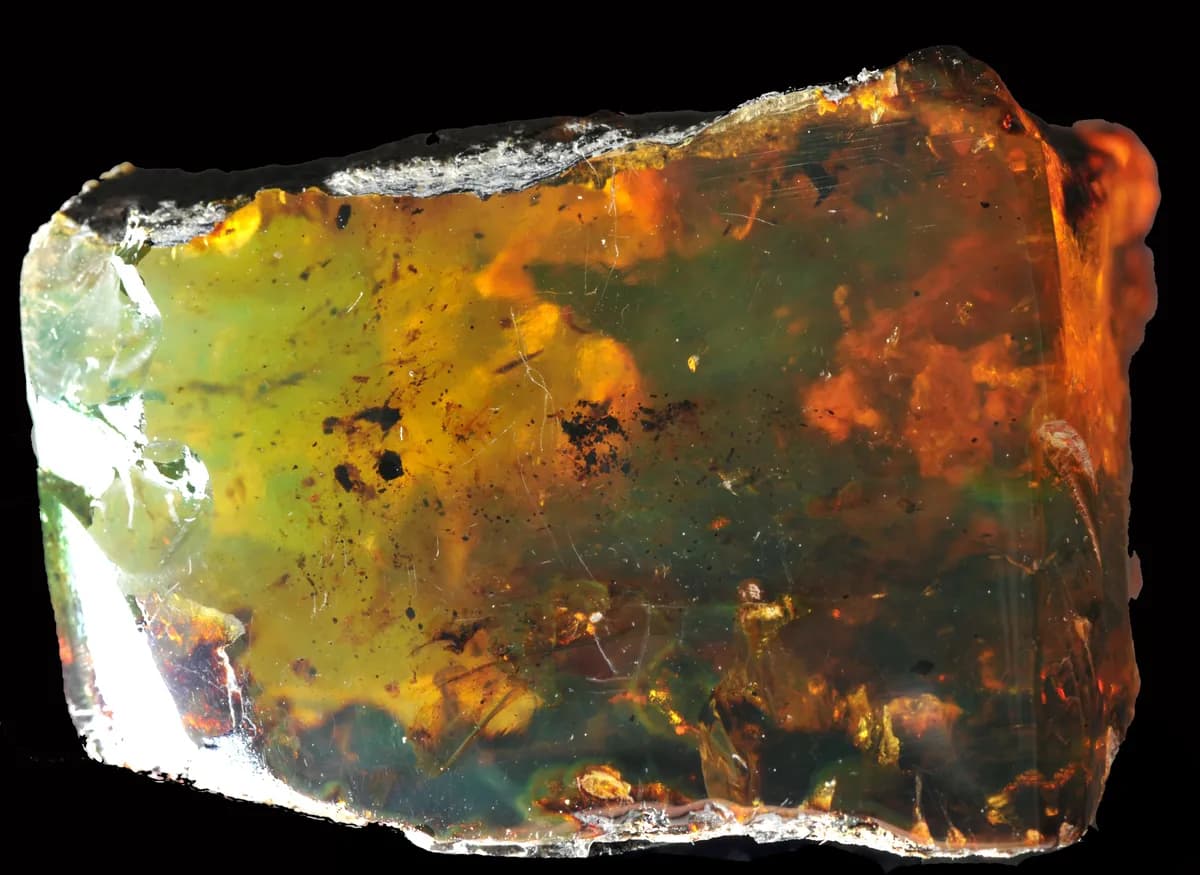
Dominican amber is fossilized resin from an extinct rainforest tree, and most current research dates it to roughly 15 to 20 million years old. It is prized worldwide for its glassy clarity, its exceptional fossil inclusions, and a rare blue variety that is mined almost nowhere else on Earth.
That mix of hard science and natural beauty made this Caribbean country the reference point for Jurassic Park. An early scene in the film takes place at a fictional Dominican amber mine, and the Amber Museum in Puerto Plata proudly celebrates the connection to this day.
This guide explains what Dominican amber actually is, why blue amber glows, what the movie got right and wrong, and how to bring home a genuine piece from Puerto Plata or Santo Domingo without being fooled by plastic.
What Is Dominican Amber?
Dominican amber is the fossilized resin of Hymenaea protera, an extinct leguminous tree that once formed dense tropical forests across the region. Over millions of years, sticky resin hardened, was buried in sediment, and slowly polymerized into the gem-like material sold today.
Its age has been debated for decades. Early studies in the 1990s suggested dates of up to 40 million years, but later work based on marine microfossils points to a Miocene age of about 15 to 20 million years, which is the range most scientists cite now, according to the research summarized on the Dominican amber reference page.
What makes it extraordinary is what it holds. Ants, bees, termites, flies, spiders, lizards, and even a microscopic tardigrade have been documented inside Dominican amber, allowing researchers to reconstruct an entire vanished tropical ecosystem in miniature.
Why Is Dominican Amber Prized Over Baltic Amber?
Baltic amber dominates the world market by volume, but Dominican amber wins on clarity. Dominican material is nearly always transparent, while much Baltic amber is cloudy or opaque.
Dominican amber also contains a higher number of fossil inclusions than Baltic amber. For collectors and scientists, a clear window onto a perfectly preserved insect is the whole point, and Dominican stones deliver that far more often.
The result is a gem that works twice: as jewelry with warm honey tones, and as a legitimate scientific archive. Some museum pieces containing whole lizards rank among the most famous amber fossils anywhere.
What Makes Blue Amber Blue?
Blue amber is not dyed and not a different mineral. The blue comes from fluorescence: aromatic hydrocarbons in the amber, chiefly a compound called perylene, absorb ultraviolet light and re-emit it as visible blue light, with emission concentrated between 430 and 530 nanometers, as explained in this overview of blue amber's color phenomena.
That is why the stone seems to change character with the light. Under ordinary indoor lighting it looks like regular golden amber, in daylight its blue surface fluorescence can be difficult to see and is usually observed against a black background, and under a UV lamp it shines a milky electric blue.
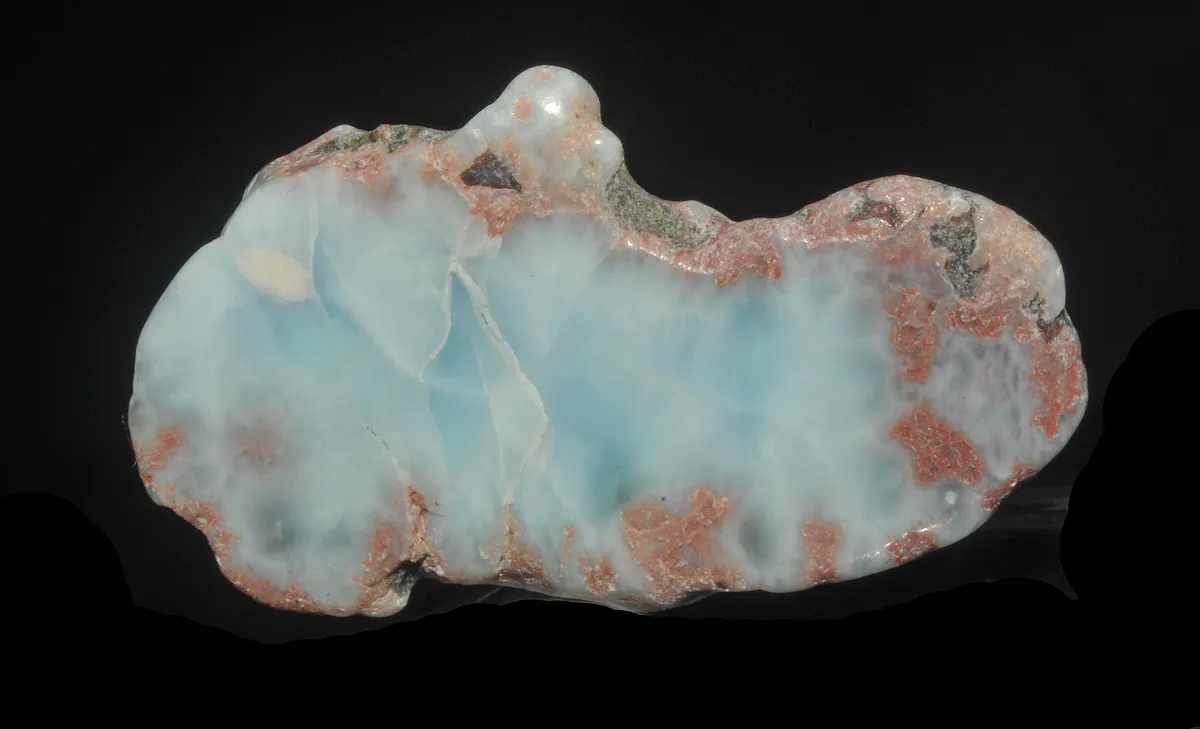
Blue fluorescent amber was documented in 1982, and it remains exceptionally rare, which is why it commands much higher prices than golden amber. If you love the color, pair it with larimar, the country's other famous blue stone, for a uniquely Dominican jewelry set.
Where Is Dominican Amber Mined?
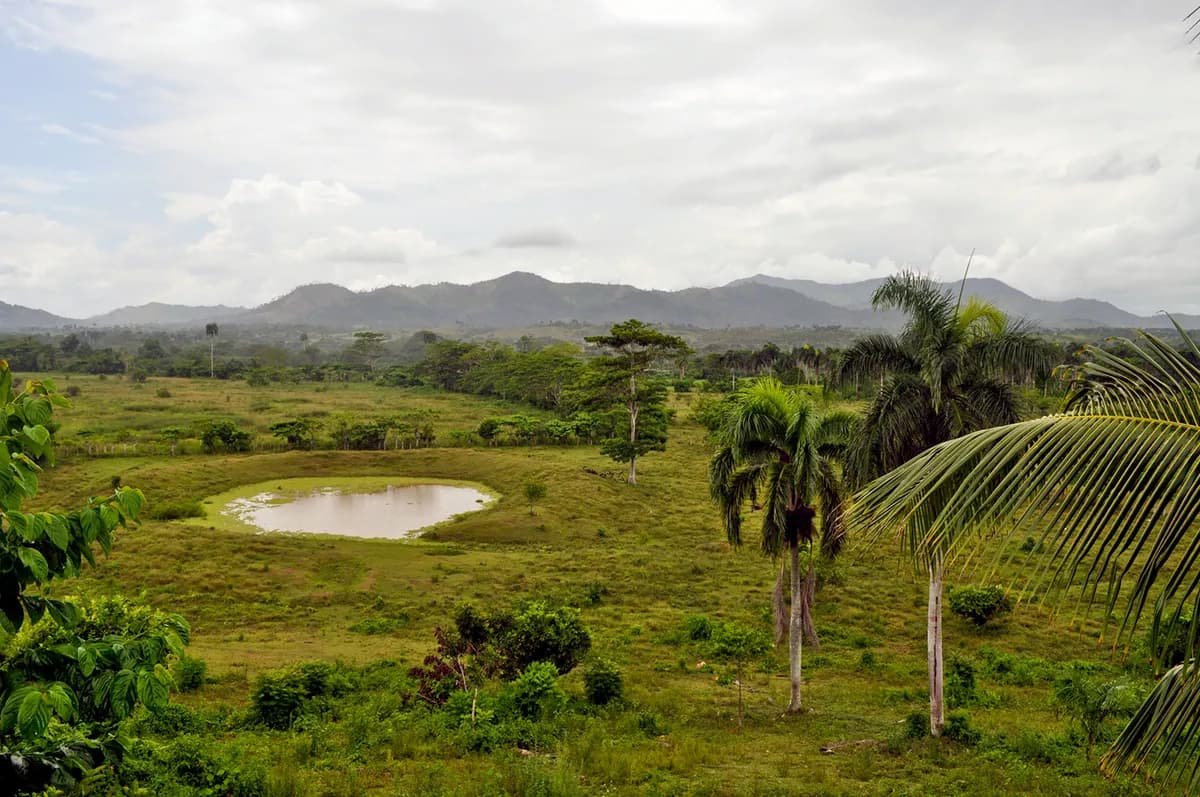
The main amber deposits sit in the Cordillera Septentrional, the mountain range running behind the north coast between Puerto Plata and Santiago de los Caballeros. Smaller deposits are worked near Bayaguana and Sabana de la Mar in the east.
Blue-green amber is found mainly in La Cumbre, Los Minguines, Guazumal, Los Guineos, and Los Cacao. These are not industrial operations but small artisanal pits dug into steep hillsides by local miners.
Because the supply chain starts with hand tools in remote mountains, output is tiny and unpredictable. That scarcity is a big part of what you pay for in a genuine blue amber pendant.
What Is the Real Jurassic Park Connection?
The story starts with real science. Entomologist George Poinar Jr. published research in 1982 showing astonishing cellular preservation in an amber-trapped fly, and Michael Crichton later contacted his lab while developing the novel that became Jurassic Park, a history traced by Smithsonian Magazine.
The Dominican link is written into the film itself. An early scene in the screenplay takes place at the fictional Mano de Dios Amber Mine, captioned on screen as being in the Dominican Republic, where the mosquito-bearing amber for the park is dug up. The scene was actually shot in Hawaii, but the setting was a deliberate nod to the country that produces the world's clearest, most inclusion-rich amber.
Real laboratories chased the fantasy too. In 1992, scientists reported extracting DNA from an extinct bee and a termite preserved in amber, headline news that landed just as the film arrived in 1993. Follow-up studies could not replicate those results, and by 1997 researchers concluded the sequences were likely contamination, so no dinosaur DNA has ever come out of amber.
Should You Visit the Amber Museum in Puerto Plata?
Yes, it is one of the best small museums in the Caribbean. The Museo del Ambar Dominicano occupies Villa Bentz, an elegant mansion completed in 1919, at Calle Duarte 61 in the historic center of Puerto Plata.
The collection spans amber pieces holding plants, insects, and small animals, including celebrated lizard specimens. The Jurassic Park room is the crowd-pleaser: a wall of press clippings from the film era and a replica of John Hammond's amber-topped walking cane, complete with a mosquito suspended inside.
The museum is open Monday through Saturday, admission costs only a few dollars, and a visit takes under an hour. It slots easily into any north coast itinerary; if you are still choosing coasts, our Punta Cana vs Puerto Plata comparison breaks down the trade-offs.
How Do You Spot Fake Amber?
Plastic and copal, a much younger resin, are the two common impostors. A few simple checks catch most fakes.
- Salt water test: genuine amber floats in heavily salted water, while most plastics sink. This is easy to do at home with a loose bead.
- UV light test: real Dominican amber fluoresces blue under a small UV flashlight, and blue amber glows dramatically. Most plastics stay dull.
- Warmth and weight: amber feels warm and surprisingly light, while glass feels cold and heavy.
- Copal check: solvent tests can also soften genuine Dominican amber, so avoid this test.
Skip the hot needle test you may read about online. It damages the piece, and no reputable dealer will allow it anyway.
Where Should You Buy Genuine Dominican Amber?
The safest purchases are at the Amber Museum gift shop in Puerto Plata and at established jewelers in Puerto Plata and Santiago. In the capital, the jewelry shops around the Zona Colonial carry certified amber and larimar side by side.
Prices scale with size, clarity, and above all inclusions: a clearly visible insect multiplies value, and strong blue fluorescence multiplies it again. Ask for a certificate of authenticity on any significant purchase.
Be wary of beach vendors selling large, flawless "amber" necklaces for a few dollars, because genuine material at that size is never that cheap. For more ideas on what to see and bring home, browse our Dominican Republic travel guides.
Frequently Asked Questions
How old is Dominican amber?
Most current research dates Dominican amber to about 15 to 20 million years, placing it in the Miocene epoch. Older figures of 30 to 40 million years still circulate in shops and older books, but they come from early studies that later stratigraphic work has revised downward. Either way, every genuine piece predates humanity by millions of years.
Is blue amber found only in the Dominican Republic?
Almost. The Dominican Republic produces the vast majority of the world's blue amber, mainly from La Cumbre, Los Minguines, Guazumal, Los Guineos, and Los Cacao. Small amounts of fluorescent amber also occur in Chiapas, Mexico, and in Indonesia, and Baltic amber can also show blue–violet fluorescence under long-wave UV illumination.
Was Jurassic Park filmed in the Dominican Republic?
No. An early scene is set at a fictional amber mine captioned "Dominican Republic," but it was filmed at Hoopii Falls on Kauai, Hawaii, and the rest of the movie was shot in Hawaii and California. The Dominican setting honors the country's real amber mines, and the Puerto Plata museum embraces that Hollywood tribute.
Can scientists really extract dinosaur DNA from amber?
No. Studies in 1992 and 1993 claimed DNA from amber-preserved insects, but the results could not be replicated, and by 1997 scientists attributed them to contamination. DNA degrades far too fast to survive millions of years, even inside amber. The movie remains science fiction, though amber genuinely preserves anatomy in stunning detail.
How much does Dominican amber cost?
Simple polished pendants in golden amber start at modest prices in local shops, while pieces with clear insect inclusions cost considerably more. Blue amber carries the biggest premium because of its rarity, with strong, even fluorescence commanding the highest prices. Size, clarity, and certification all move the price, so compare a few reputable sellers first.
Facts on this page were last compared with their sources on . Details may have changed since. How we check
About the author
Alex Borshch
Keep reading
Related articles
Practical updates, new guides, and trip-planning notes
Join the launch list for practical Dominican Republic travel updates, new guides, and trip-planning notes. No mail app required.