Sargassum in Punta Cana: Seaweed Season Month by Month
When seaweed season hits Punta Cana, which beaches stay clearer, how 2026 compared and how to check conditions before you go.
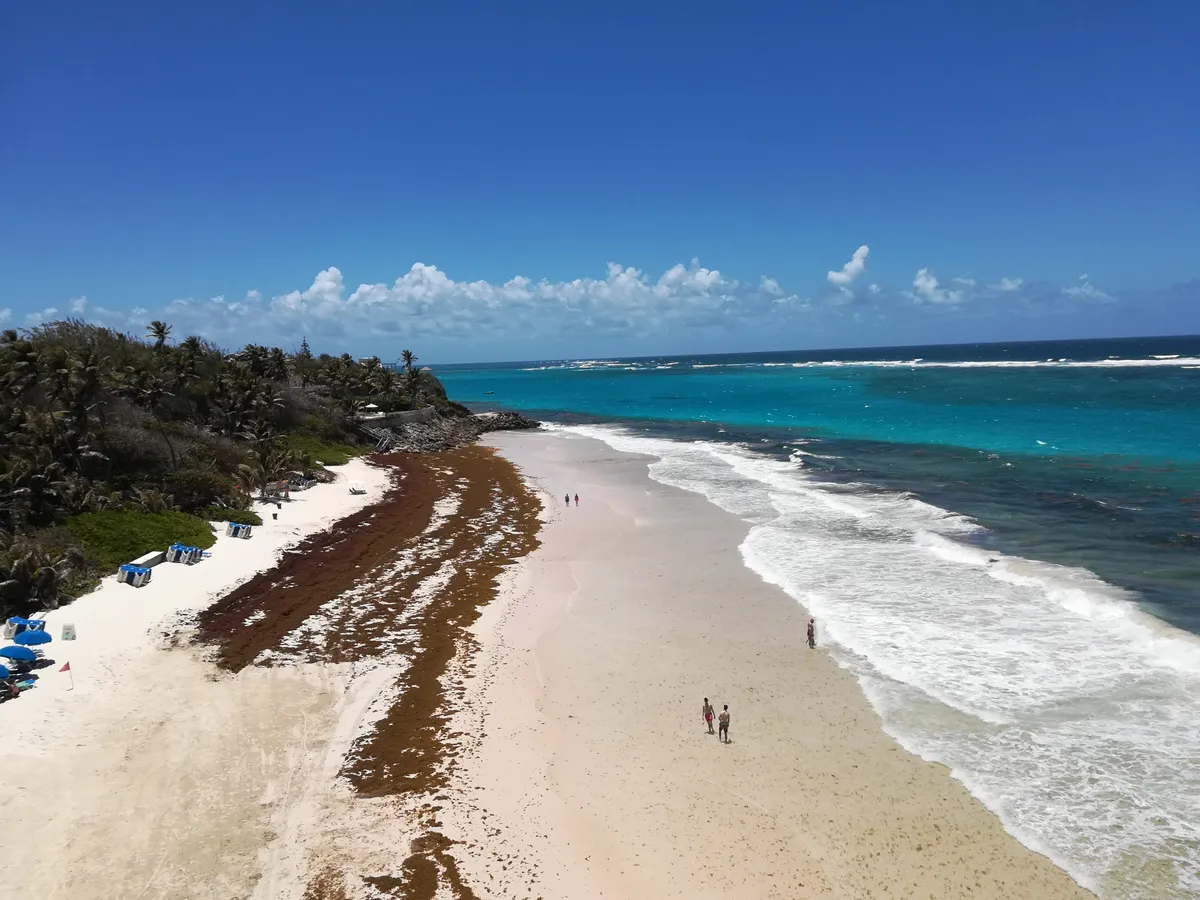
Sargassum in Punta Cana follows a yearly rhythm: it usually builds through spring, peaks in summer and falls away by late autumn, so late autumn and winter are normally the clearest stretch and June to August the riskiest. The amounts change from year to year, though, and 2026 was one of the two largest seasons on record, with heavy seaweed in the region from March. This guide explains the pattern month by month, which beaches cope best, and how to check conditions before you travel. It reflects the scientific bulletins available on 16 November 2026.
What Is Sargassum and Why Does It Reach Punta Cana?
Sargassum is a brown seaweed that floats in large mats on the open ocean. It is a natural habitat for fish and young turtles at sea. The trouble starts when it lands on a beach in bulk, rots, and turns the shallows brown.
Since 2011, scientists have tracked a vast band of it stretching across the tropical Atlantic, known as the Great Atlantic Sargassum Belt. Researchers at the University of South Florida (USF), who monitor it by satellite, link its growth mainly to nutrients, from the Amazon's outflow and from deep water rising off West Africa, and to changes in winds and currents. The causes are still debated. Currents then push the mats west into the Caribbean.
Punta Cana faces east, straight into that flow. The long open beaches of Bávaro and Arena Gorda are among the first Dominican shores the seaweed meets.
When Is Sargassum Season in Punta Cana?
USF describes the typical cycle like this: the seaweed grows through late spring, peaks around summer, and declines by late autumn or early winter, with the yearly low around November. Growth resumes soon afterwards, slowly at first, through the winter. We found no official month-by-month record for Punta Cana's beaches, so the table below is a guide built from that regional cycle, not a forecast.
| Months | Typical risk | What to expect |
|---|---|---|
| November to February | Lowest | The belt is at or near its yearly low. Beaches are usually clear, with occasional patches, more so in a big year. |
| March to April | Rising | The new season begins. Often fine, but in big years seaweed arrives early. |
| May | Moderate to high | Amounts in the Atlantic climb quickly. Conditions vary week to week. |
| June to August | Highest | Peak of the season. Expect seaweed on exposed east-facing beaches on many days. |
| September to October | Falling | The belt shrinks, but landings continue at lower strength. |
Two things matter more than the month. First, the size of the year's bloom. Second, the wind and current on the day: a beach can be covered on Monday and clear by Thursday.
How Bad Was 2026?
It was a heavy year. USF's monthly bulletins tell the story:
- February: record levels for the month in almost every region, with the researchers warning that another major year was taking shape.
- March and April: record highs again. By mid-April sargassum had spread across the whole Caribbean Sea.
- May: another monthly record in nearly every region.
- June: the total was about 10 per cent below the 2025 record, making 2026 "at least the second largest" year.
- July and August: amounts fell in all regions, and by the end of August the belt had roughly halved.
- October: totals more than halved again in most regions. USF expected the decline to continue until about late November or December, with beaching at much lower severity.
For comparison, the largest amount ever measured was about 38 million tonnes across the Atlantic, reached in May 2025 and matched that July. Before 2025, the record was roughly 22 million tonnes, in June 2022.
The lesson of 2026 is that the old rule of thumb, "fine until May", does not always hold. In a big year the season starts in March.
Which Beaches Have the Least Seaweed?
There is no official ranking, and what follows comes from local operators and satellite-based trackers, so treat it as a tendency.
- Most exposed: the open, east-facing stretches of Bávaro and Arena Gorda, where most of the big resorts stand.
- Often better: the reef-protected coves of Cap Cana, such as Juanillo, according to local dive operators. Cabeza de Toro faces east like Bávaro and gets no such shelter.
- Usually clear: the Caribbean coast around Bayahibe and Dominicus, about an hour south-west, which faces away from the main flow and is partly sheltered by Saona Island. It is not exempt: seaweed reached Bayahibe's beaches too in 2026.
- Less affected: the north coast around Puerto Plata, according to the same trackers. Our Punta Cana vs Puerto Plata comparison covers the other differences.
No coast is immune. In 2026 a clean-up was organised at Playa Rincón on the Samaná peninsula, far from Punta Cana.
What Do Resorts and the Government Do About It?
Large hotels clear their beachfront every day with machinery and crews, which is why a resort beach can look fine while the public stretch next door does not. Some hotels also float barriers offshore to deflect the mats. Smaller hotels rely on workers with rakes and wheelbarrows.
The clean-up has limits. In a heavy week seaweed can arrive faster than it is removed, and the water close to shore may stay brown even when the sand is clean.
At national level, the tourism ministry and the hotel association Asonahores agreed a five-year fund of about US$11.8 million in November 2020 for barriers along Punta Cana, Bávaro, Cabeza de Toro and Uvero Alto. Progress has been slow. In June 2026 the tourism minister, David Collado, said US$9 million was sitting in an Asonahores account, to be released once a long-term way of collecting seaweed at sea is found, and that cleaning the shore alone does not solve the problem. Hoteliers have pressed for the barrier programme to be approved quickly.
Is Sargassum Harmful?
The seaweed itself is not toxic. Public health guidance from Florida, which faces the same seaweed, makes these points:
- Rotting piles give off hydrogen sulphide, the gas that smells of rotten eggs. On an open beach, where the breeze disperses it, it is not expected to harm the general public.
- People with asthma or other breathing conditions are more sensitive. If your eyes or throat sting, move away from the piles.
- Tiny sea creatures living in the mats can sting and cause rashes, so the advice is to avoid handling the seaweed or swimming close to it.
How Can You Check Conditions Before You Go?
- USF monthly outlook. Published at the end of each month by the Optical Oceanography Lab, and reposted by CARICOOS, the Caribbean ocean observing network. It tells you whether the season is large or small and which regions are in the firing line. It does not forecast individual beaches.
- NOAA's Sargassum Inundation Risk maps. These colour stretches of coast by risk, based on how much floating seaweed satellites detect in the waters offshore. They are experimental and estimate what is near the coast, not what lands.
- Your hotel. Ask for a photo or video of the beach and the waterline taken that week. Recent guest photos on review sites are useful too.
Satellites cannot see through cloud and detect seaweed poorly close to the shore, so the only reliable view of a beach is a current picture of it.
How Do You Plan a Trip Around It?
- Pick your months. If a clear beach is the priority, November to February gives the best odds. December to April is also the dry, busy and more expensive season, while November is usually cheaper. See our best time to visit guide.
- Choose the hotel for its pool as well as its beach if you travel between May and September.
- Consider where you stay. A resort in Cap Cana or on the Bayahibe coast lowers the risk in summer without removing it.
- Do not expect a refund. We found no Punta Cana hotel that publishes a sargassum guarantee. Flexible booking terms are your protection.
- Have a plan for bad days. A boat trip to Saona Island or Catalina Island takes you to the sheltered Caribbean side. The freshwater lagoon of Hoyo Azul is inland. Dive sites offshore are not affected by seaweed on the beach.
Is It Worse Than Cancún?
Both destinations face the same belt, and both had a hard 2026. Mexico's navy reported more than 123,000 tonnes collected along the Mexican Caribbean coast by early September 2026, about a third more than in the whole of 2025. Dominican hoteliers cited that coast as the situation they want to avoid. Our Punta Cana vs Cancún comparison looks at the two destinations more widely.
Frequently Asked Questions
What months does Punta Cana have seaweed?
The risk is highest from June to August and lowest from November to February. In large years, such as 2026, seaweed can arrive from March.
Is there sargassum in Punta Cana in December?
December falls in the low part of the cycle, soon after the Atlantic belt's yearly minimum. Beaches are usually clear, though patches are possible, especially after a big year.
Which side of the Dominican Republic has no seaweed?
No coast is guaranteed clear. The Caribbean side around Bayahibe and Saona, and the north coast, are usually less affected than east-facing Punta Cana.
Can you swim when there is sargassum?
The seaweed itself is not toxic, but small organisms in the mats can sting and irritate the skin, so health guidance is to avoid swimming close to it. Avoid rotting piles if you have asthma.
Do resorts in Punta Cana clean the seaweed?
Large resorts clear their beachfront daily, and some use offshore barriers. In heavy weeks the seaweed can arrive faster than it is removed.
Is Cap Cana better for sargassum than Bávaro?
Local operators report that Cap Cana's reef-protected coves, such as Juanillo, are often clearer than the open beaches of Bávaro, but there is no official data.
How can I check sargassum in Punta Cana today?
Ask your hotel for a current photo of the beach. Satellite outlooks from USF and NOAA show the regional picture, not individual beaches.
About the author
Alex Borshch
Keep reading
Related articles
Practical updates, new guides, and trip-planning notes
Join the launch list for practical Dominican Republic travel updates, new guides, and trip-planning notes. No mail app required.